
- v0 (by Vercel) writes real Next.js apps: Design Mode, Figma import, a private GitHub repo with pull requests, and hosting on Vercel.
- Bob is an AI coworker who builds small internal apps when the job needs one, hosted for you and private to your workspace by default.
- v0 is priced per user ($30/user/mo on Plus), and Vercel hosting is billed separately. Bob is one workspace fee from $75/mo, hosting included in your credits.
- Keeping a v0 app private means Vercel accounts, a $20/mo password add-on per project, or Enterprise sign-in. A private Bob app opens for your workspace members.
- Keeping a Bob app running costs about $3 a month in credits if your team uses it a few hours each workday, and about $15 if it is busy around the clock. And it can use the 3,200+ apps your team already connected to Bob from day one.
- Building a product with engineers in the loop? v0 fits that workflow. Need a tracker for your team today? Bob gets there with one message.
What v0 is
v0, from Vercel, describes itself as “your collaborative AI assistant to design, iterate, and scale full-stack applications for the web.” You build from a chat, screenshots or a Figma file, refine in Design Mode, and v0 writes Next.js, React and Tailwind code into a private GitHub repo, working on a branch per chat and opening pull requests.
Apps deploy to Vercel with previews for every branch. One click adds Neon, Supabase, Upstash or Vercel Blob; logins come from Better Auth; Stripe is built in. Vercel Connect (beta) lets apps reach Slack, Salesforce, Gmail and more. v0 sits inside Vercel's SOC 2 Type 2 report, and Vercel holds ISO 27001.
What Bob is
Bob is an AI coworker. Your team asks him for work in Slack or in the HeyBob app for Mac, Windows and Linux, and he does it across the 3,200+ apps you connect: the report, the follow-up email, the update in the CRM. Writes wait for an Approve button by default, and every finished job posts a receipt with what it cost.
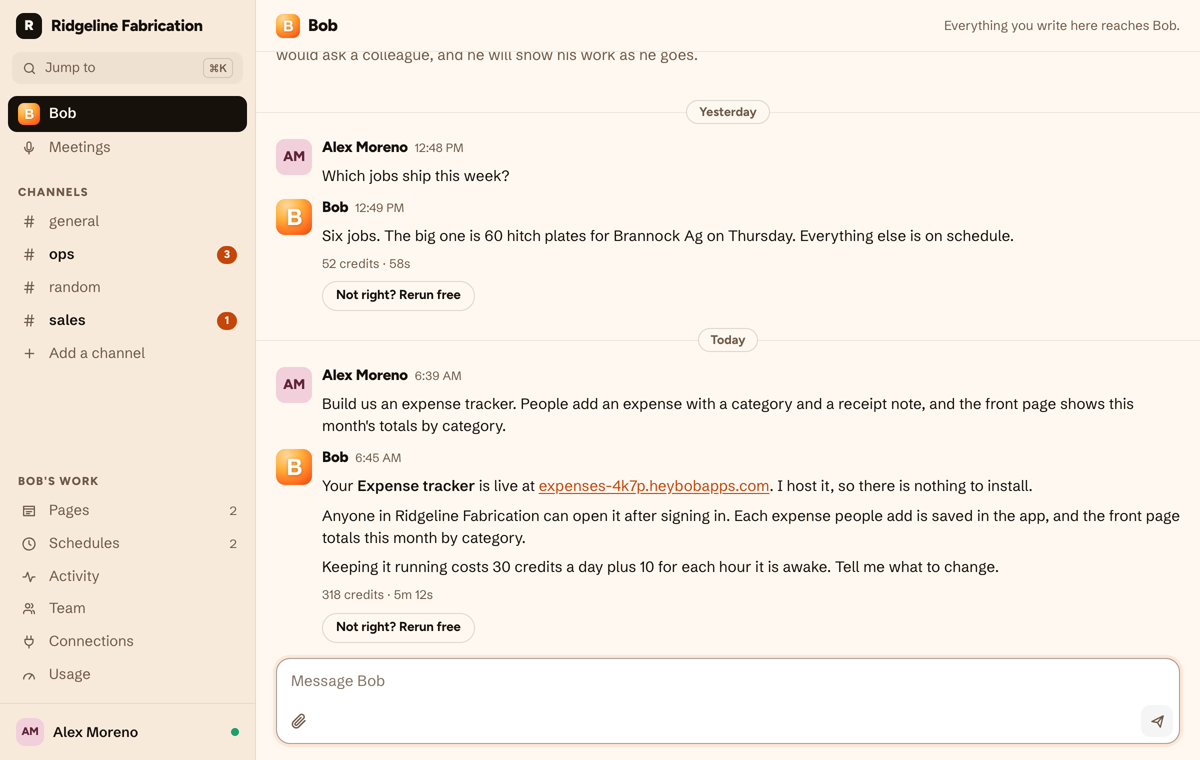
Sometimes the job is a small tool, and then Bob builds it. Ask for an expense tracker or a request board and he builds a small web app with its own database, hosts it at its own address, and keeps it private to your workspace unless you say otherwise. If the job is a view of numbers you already have, he builds a page instead, which costs nothing to keep.
A product team’s tool, or a coworker for everyone else
v0 is made for product teams: real code, a Git and pull-request workflow, design fidelity and Vercel's hosting. Someone owns the repo, the Vercel project and the bill. That is the right shape when the app is part of what you ship.
Bob is for the rest of the company. Your team asks him for reports and follow-ups in Slack or the HeyBob app, and your tools are already connected. When a job needs a small tool, he builds it in the same thread, hosts it, and keeps doing the work around it. There is no repo, no hosting account and no per-user builder seat. The tradeoff is depth: Bob's apps are small internal tools, not products.
Use the data you already have
Most app builders start you from an empty database, then ask you to wire up connectors, keys or server code to reach your business data. With Bob, that part is already done. Your team connects its tools to Bob once, by asking (“connect HubSpot”), pressing Connect and signing in, and 3,200+ apps are on the menu.
When Bob builds an app, it can read those same tools, and write to them if you allow it, through the connection of the person who asked for it. That person approves each tool before the app goes live. Your Google Sheets, HubSpot deals or Gmail are in the app on day one, with no keys or server code. v0’s Vercel Connect is in beta, and the tools v0 uses while building are not available to the finished app.
What it costs to keep an app running
Bob’s apps are billed in the same credits as the rest of his work: 30 credits a day to keep an app, plus 10 for each hour it is awake. When nobody is using it, it sleeps. At the entry plan’s rate ($75 for 40,000 credits), that works out like this:
| How much your team uses the app | Credits a month | In dollars |
|---|---|---|
| Opened now and then | About 1,000 | Under $2 |
| A few hours each workday | About 1,560 | About $3 |
| Busy around the clock | About 8,100 | About $15 |
Those credits come out of the workspace plan you already have, which is $75 a month (half price through December 31, 2026) and covers everything Bob does. So an app is a small slice of an existing bill, not a new subscription. If an app builder is all you want, v0 costs less to start.
On v0, Plus is $30 per user a month, and a commercial app needs Vercel Pro hosting, from $20 a month plus $20 per extra deploying seat. Letting teammates without Vercel accounts into a private app takes the $20-a-month password add-on per project, or Enterprise.
Side by side
What Bob’s apps do not do yet
We would rather you hear the limits from us than find them after you build.
- An app does not know who is using it yet. So there are no per-person views, roles or approvals inside an app.
- No custom domains, file uploads, payments or email sent from an app yet.
- No code export. Bob owns the build: you describe the change, he makes it.
- Signing in to a private app goes through Slack today. Teams on the HeyBob app without Slack can use public apps.
- A sleeping app takes a couple of seconds to wake up.
Which one should you pick?
Pick v0 if…
- Your engineers want real Next.js code, a GitHub repo and pull requests.
- Design fidelity matters: Figma import, Design Mode and your team's design system.
- You already run on Vercel and want previews, rollbacks and observability.
Pick Bob if…
- You need a small tool for your team, not a codebase or a Vercel project.
- Your teammates should open private apps without Vercel accounts or a password add-on.
- You want one coworker who builds the tracker and keeps doing the work around it.
- You would rather pay one workspace fee than a builder seat per user plus hosting.
Plenty of teams will use both: v0 for what the product team ships, Bob for the tools and busywork around the company.
Fair questions
Is Bob a good v0 alternative?
For small internal tools, often yes: ask Bob in Slack or the HeyBob app and he builds, hosts and changes the app for your team. For a product your engineers will own, no. v0's code, Git workflow and Vercel hosting are what that job needs.
Can I export the code of an app Bob builds?
No. Bob keeps the code and changes it when you ask. v0 writes into a private GitHub repo and offers a zip download.
Do my teammates need an account to open the app?
A private v0 app opens for Vercel team members, people with a shareable link, or anyone with the password if you buy the $20-a-month add-on. A private Bob app opens for members of your HeyBob workspace after they sign in, which today goes through Slack.
How do the prices compare?
v0 Plus is $30 per user per month and Business $100 per user per month, and Vercel hosting is a separate bill. Bob is one workspace fee from $75 a month for 40,000 credits that cover everything he does, including hosting; an app costs 30 credits a day plus 10 for each hour it is awake.
Does either one train AI on my data?
Bob never uses your data, prompts or connected-tool content to train AI models. v0 says prompts may be used to improve its products through third-party models unless a team opts out, which is the default on Business and always on for Enterprise.
v0 and Vercel are trademarks of Vercel, Inc. HeyBob and Bob are products of Tiny Cloud Ventures. Comparison reflects public information as of October 6, 2026.